Alexandra Humbel
  • Home
  • About
  • Coaching
  • Acclaimed Lives
  • Blog
  • Contact
  • Book a Call
  • English
    • Français
    • English
  • Menu Menu
  • Link to LinkedIn
  • Link to Facebook

Impostor Syndrome and Leadership: The Secret Fear No One Talks About

Emotional Intelligence, Leadership, Personal Development, Uncategorized

A recent special edition of The Economist explored Impostor Syndrome, confirming what many of us already experience firsthand: this quiet struggle is deeply embedded in today’s workplace. Not that I needed external validation. I see it regularly in my work. Different industries, different levels of seniority, different personalities — yet the same underlying tension emerges again and again.

Highly capable professionals confide in me about a persistent inner voice that questions their legitimacy. It whispers — sometimes it shouts — that they are not truly up to the task, that they were hired by accident, that their success is somehow a misunderstanding. Entrepreneurs tell me they fear their company was born out of reckless boldness rather than competence. Executives dread the moment someone will “finally realize” they are not as capable as they appear.

Externally, they project composure. Internally, they are exhausted. It takes extraordinary energy to look confident while suppressing the fear of being exposed as a fraud. That silent effort drains attention and creativity — resources that could be invested far more productively elsewhere.


The Hidden Companion of High Performers

What is striking is that this feeling of “never quite enough” rarely appears out of nowhere. It is often the shadow side of a performance-driven education and professional culture. From an early age, we are encouraged to aim higher, push harder, outperform expectations, and constantly improve. Achievement becomes the baseline. Satisfaction remains elusive.

The bar keeps moving, and whatever we accomplish quickly feels insufficient. The very mindset that fuels excellence also plants the seeds of chronic self-doubt.

And here is something equally important: you are not alone in this. A significant number of the people you admire most are wrestling with the same internal dialogue. You simply do not see it, because they hide it just as carefully as you do. Impostor Syndrome tends to visit those who care deeply about their work, who set high standards, and who strive to contribute meaningfully. In that sense, it may say more about your ambition than about your inadequacy.

A Signal of Growth, Not Proof of Fraud

Interestingly, Impostor Syndrome often surfaces at very specific moments: before taking on a stretch assignment, before stepping into a new leadership role, before launching something bold, or before navigating unfamiliar territory. It rarely appears when we are comfortably operating within our existing competencies.

That pattern is revealing.

The feeling may not signal incompetence; it may signal growth. It tends to arise precisely when we are expanding our perimeter.

The real difficulty is not that the feeling exists. The difficulty lies in carrying it unconsciously — like a backpack filled with stones — investing enormous energy in managing the discomfort rather than directing that energy toward meaningful projects.


Unmasking the Inner Voice

At some point, it becomes necessary to turn around and examine it more closely. Whose voice is this, really? Where did it originate?

Many high-profile professionals discover that their harshest inner critic echoes comments heard decades earlier — from a teacher, a parent, a peer. Some remarks were openly critical; others were framed as protection or motivation. The objective is not to assign blame but to create separation. Those voices belong to the past. They do not have authority over your present.

Does Impostor Syndrome ever disappear entirely? Probably not. As long as you are ambitious, curious, and willing to stretch beyond your comfort zone, it may resurface from time to time. But it does not have to paralyze you. It can become something else — a signal that you are entering territory that matters, that you are evolving, that you are playing a bigger game.

Seen through that lens, Impostor Syndrome is less an indictment and more a compass. It points toward growth. And perhaps the presence of that discomfort is not evidence that you do not belong — but proof that you are expanding into your next level.


by Alexandra Humbel
https://alexandrahumbel.com/wp-content/uploads/2026/02/iStock-2195071142.jpg 836 1254 Alexandra Humbel https://alexandrahumbel.com/wp-content/uploads/2024/08/alexandra-humbel-logo-tag.png Alexandra Humbel2026-02-24 17:31:232026-03-04 11:18:44Impostor Syndrome and Leadership: The Secret Fear No One Talks About

Too Young at 30, Too Old at 45: Welcome to Workplace Ageism

ageism in workplace, Leadership, Personal Development

An article recently published in Les Echos — the French economic newspaper of record — commented on a new survey about age discrimination at work. According to Eurostat, the average working life spans 36 years. Yet many companies still believe the “golden age” for career acceleration is between 30 and 45. Is that really it? A 15-year window — and then… what? No hope?

Fifteen years sounds like a lot. Until you compare it to the 40+ year arc of your working life. Then it feels cruelly short

More than two-thirds of the 1,300 men and women surveyed by Ipsos BVA between April and June 2025 for the association Grandes écoles au féminin (GEF) agree. And 68% say their age has already held them back at work.
And it’s not just older professionals. Younger ones are trapped too.
You studied for years. You broke into the job market — sometimes with grit, sometimes with luck. You climbed, slowly, painfully, with sweat and sleepless nights. Now you’re in your 30s — finally out of the woods, finally “in.” And now? This is your window. The one that will slam shut before you know it.

Oh — and if you’re a woman? It gets worse

Because 30–45 is also when many of us choose to start families. To have children. And let’s be honest: maternity leave and early childcare? Not exactly career accelerators.
So here you are — double-layered pressure. “Make it or break it” before your kids even hit high school.
Now, from the other side of the window — late 40s — does it get better?
You’ve earned credentials. You’ve mastered competencies. You’ve stayed current — no, you’re not behind on tech. Thank you for asking.
Does that experience bring comfort? It should. But here’s the cruel paradox: the more capable, the more eager to learn, the more ready to share your magic with your team — the more you hit the invisible wall. It has a name: seniority bias.
Let’s be real: with retirement ages rising globally, we’ll all be working into our 60s. That’s not a bug — it’s a feature. We’re living longer, healthier lives. So why are we still clinging to century-old clichés that people over 50 are “less productive”?
And let’s not pretend this hits everyone the same.
Women — of all ages — get the double whammy.
When you’re young? You hear it. “Too young.” “Not seasoned enough.” “Still figuring things out.” Comments that never seem to land on your male peers.
When you’re older? The invisible wall thickens. Promotions stall. Pay raises vanish. Recognition fades — while your male counterparts? They keep climbing. Quietly. Steadily. Unbothered.
It’s not a coincidence. It’s biased. Layered. Gendered. Ageist. And it’s costing companies talent — and costing women their rightful place at the table.

The only thing that matters? How you act

I could rant about this double-bind for days — the no-win trap where professionals face precarity for no reason, and companies starve themselves of seasoned, high-value talent — all because of outdated prejudices.
Knowledge is power. So don’t look away. Don’t pretend it doesn’t exist.
You don’t have to let ageism undermine you. You have to outsmart it.
Define your strategy. Own your value. Go get what’s yours — a fulfilling, impactful career — no matter where you are in your journey.


by Alexandra Humbel
https://alexandrahumbel.com/wp-content/uploads/2026/02/IMG_1324.jpg 768 1365 Alexandra Humbel https://alexandrahumbel.com/wp-content/uploads/2024/08/alexandra-humbel-logo-tag.png Alexandra Humbel2026-02-24 11:30:152026-03-05 11:44:21Too Young at 30, Too Old at 45: Welcome to Workplace Ageism

Still Relevant After 60 Years: The Rolling Stones Reinvention Playbook

Career Transitioning, Leadership
LIKE A ROLLING STONE - Alexandra Humbel CoachingMark Seliger - The Guardian
LIKE A ROLLING STONE - Alexandra Humbel Coaching

Photograph: Mark Seliger – The Guardian

Back in 1972, Mick Jagger famously declared:
“When I’m 33, I’ll quit – I don’t want to be a rock star all my life. I couldn’t bear to be like Elvis Presley and sing in Las Vegas with all those housewives and old ladies coming in with their handbags. It’s really sick.”

Well.

Jagger didn’t exactly take the Elvis route to Vegas. Instead, he built his own roller-coaster artistic road — one marked by astonishing longevity, relevance, and creative stamina.

Why am I gushing about the Rolling Stones in a “second act of life” conversation?

Because they are a masterclass in reinvention.

Not survival. Reinvention.

It’s easy to stay visible by replaying old hits. Nostalgia sells. Many artists tour on memory alone.

But the Stones? They kept creating.

Their secret sauce is not continuity. It’s transformation

Think about it: over six decades, how many musical waves have they navigated? Rock, blues revival, disco influences, stadium anthems, digital streaming eras. There were quieter periods. There were storms. But when they resurfaced, they didn’t look like a tribute band to their former selves.

They adapted without losing their essence.

That distinction matters.

Reinvention is not about erasing who you were. It’s about expanding it.

And then there is the other gem: the power of the team

Tabloids have speculated for decades. Egos, tensions, separations. Yet somehow, they repeatedly regrouped. Reinvention is rarely a solo act. Long-term creativity requires relationships resilient enough to withstand friction.

When I see someone discouraged about their career — worried about age, relevance, or having “missed their moment” — I sometimes want to press play on “Angry,” from their latest album Hackney Diamonds.

The video features a young actress — born decades after the band’s first success — driving past giant screens showing archival images of the Stones. It’s playful. Self-aware. Slightly ironic.

A beautiful metaphor.

They honor their past without being trapped by it. They don’t take themselves too seriously. They welcome the new generation while still offering something fresh.

That, to me, is what a powerful second act looks like.

So when life feels uncertain, here’s to the Rolling Stones — living proof that relevance is not a matter of age, but of energy.

And that sometimes, the best response to doubt is simply to keep rocking.

by Alexandra Humbel
https://alexandrahumbel.com/wp-content/uploads/2024/03/LIKE-A-ROLLING-STONE-Alexandra-Humbel-Coaching.jpg 595 1000 Alexandra Humbel https://alexandrahumbel.com/wp-content/uploads/2024/08/alexandra-humbel-logo-tag.png Alexandra Humbel2024-03-12 08:06:372026-02-18 17:37:55Still Relevant After 60 Years: The Rolling Stones Reinvention Playbook

What Got You Here Won’t Get You There: A Career Lesson from the Fashion World

Coaching Stories, Leadership, Success Stories
Soldier to Leader

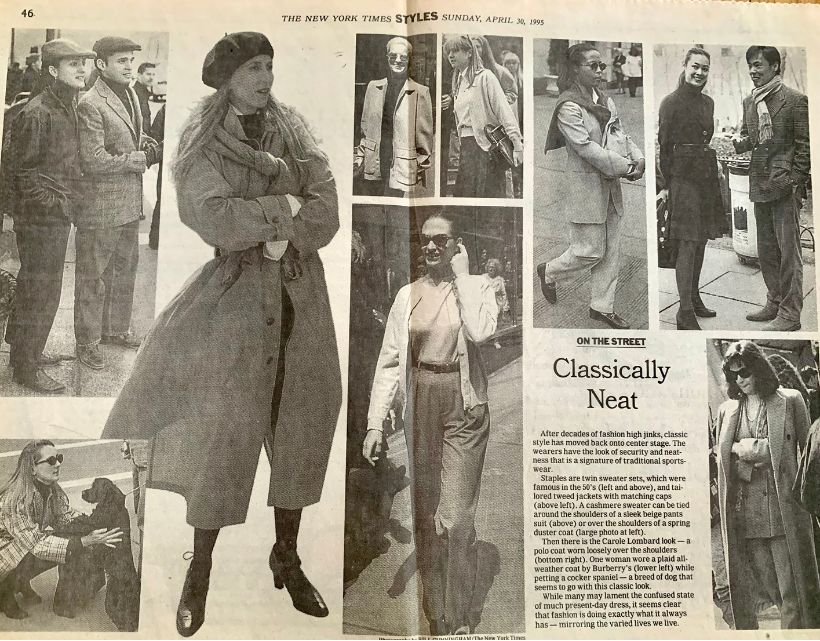
In this picture, it’s me—arms crossed, wearing a beret—unknowingly photographed at the exit of the Fall/Winter 1995 fashion show in Bryant Park, New York.

The next day, I was flying back to Paris. Imagine my surprise when colleagues called to say, “You’re in today’s fashion section of The New York Times!”

What strikes me today is the title of the article. “Classically neat.” An incredibly accurate description of who I was at the time.
Here’s why.

Powerful fashion brands are defined by image. That image is not accidental—it is carefully coded, like a language. Every detail reinforces the narrative: product, advertising, media relations, retail design, events, social media, packaging… Everything must tell the same story.
The codes apply to the team. We dressed “Ralph Lauren.” We spoke “Ralph Lauren.” We breathed “Ralph Lauren.” We did it willingly, because the designer had created not just clothes, but a world—an aesthetic of cool elegance reflected in the company’s culture. Frankly, it was a beautiful world to belong to.

Being a Good Soldier — and Loving It

There is abundant literature about leadership. Much less about the value of being a good soldier.
At that stage of my career, being a soldier worked for me. I was immersed in an environment overflowing with opportunities to learn. As a PR Officer, I was exposed daily to journalists, creatives, executives, crises, deadlines. I absorbed knowledge like a sponge.
Was I demonstrating visionary leadership? Probably not. I was efficient, reliable, accountable—a busy bee determined to master the job quickly and thoroughly.

And it paid off.

An opportunity opened to lead PR for a department with a strong entrepreneurial dimension. The team was small, largely US-based, and required autonomy. My deep understanding of the brand’s codes and culture became a strategic advantage. I could embody the brand effortlessly.

When Mastery Becomes a Limit

A few years later, something shifted.
New collaborators arrived from other fashion and luxury houses. They brought fresh perspectives, new marketing strategies, innovative approaches to storytelling. As I listened, I felt a subtle tension inside me. Part of me resisted: This is not how we do things here. Another part was intrigued: That’s actually brilliant.

I realized I had become a guardian of the codes. I knew how to execute them perfectly. But I was no longer questioning them.

My references were solid—but narrow.
I was on the wrong side of innovation.

Marshall Goldsmith famously said, “What got you here won’t get you there.” The habits, reflexes, and strengths that helped me thrive in one chapter were not the ones that would help me grow in the next.
And this is the quiet trap of early success: you start confusing excellence with permanence.

Time to Break the Frame

That New York Times photo captured more than a look. It captured an identity. “Classically neat” was not only about style—it was about alignment, discipline, belonging.
But growth requires expansion.
There is a time to be the good soldier. A time to master the codes. A time to absorb and execute.
And there is a time to step back and ask:

Am I still learning?

Am I still expanding?

Or am I protecting what I already know?

Comfort is seductive, especially when it looks like success.
But evolution demands curiosity. It demands the courage to question the very system that once elevated you. It demands stepping out of the frame—even when you look perfectly composed inside it.
Looking at that picture today, I feel gratitude. That version of me was exactly who I needed to be at that time.
But she was not meant to stay there.
And neither are you.

by Alexandra Humbel
https://alexandrahumbel.com/wp-content/uploads/2023/03/NY-Time-April-95-1.jpg 641 820 Alexandra Humbel https://alexandrahumbel.com/wp-content/uploads/2024/08/alexandra-humbel-logo-tag.png Alexandra Humbel2023-03-01 00:57:352026-02-12 19:37:38What Got You Here Won’t Get You There: A Career Lesson from the Fashion World

When Experience Becomes a Liability: Rethinking Career Strategy After 50

Leadership

As debates over extending the retirement age continue worldwide, a stark reality remains: senior unemployment has become a structural issue. Previous attempts to address it have fallen short. An entire generation now finds itself caught between the obligation to work longer and a shrinking horizon of meaningful opportunities.

While governments and companies must play their part, experienced professionals cannot afford to remain passive. Relying solely on competence, loyalty, and past performance is no longer enough in a rapidly evolving marketplace. Waiting for circumstances to decide your future is a risk. Instead, proactive reinvention becomes a necessity.

Recognizing the Structural Gap

It is encouraging to see governments beginning to acknowledge the disconnect between the demand for experienced talent and the limited opportunities available. The French government’s consideration of an age equality index signals growing awareness. But awareness is not action. Sustainable change requires concrete incentives, measurable accountability, and real investment.

Taking Ownership of Your Career Horizon

Even as systemic reforms unfold, the responsibility to shape your next decade remains yours. Job security is no longer guaranteed — nor is it always desirable. The professional landscape is shifting. Skills evolve. Business models change. Expectations transform.

The question is not whether change will happen. The question is whether you will anticipate it.

You Are Not Alone

If you feel caught in this tension, you are not isolated. Many experienced professionals face the same paradox: required to work longer, yet subtly pushed aside. The discomfort is collective — but so is the opportunity.

The power you hold is timing. You can choose when to reflect, reassess, and reposition.

Where Do You Stand?

The most strategic career moves are rarely made in panic. They are made in moments of relative stability. Take the time to evaluate your assets, your relevance, your aspirations. Approach this stage not from fear of decline, but from anticipation of what can still be built.

Structural ageism is real. But so is your capacity to adapt, reposition, and expand your impact.

This is not the end of the story. It may well be the beginning of your most intentional chapter.

by Alexandra Humbel
https://alexandrahumbel.com/wp-content/uploads/2022/10/273c6356-c934-4621-96f6-764f161a01c2.jpg 1066 1600 Alexandra Humbel https://alexandrahumbel.com/wp-content/uploads/2024/08/alexandra-humbel-logo-tag.png Alexandra Humbel2022-10-18 09:01:232026-02-11 17:58:25When Experience Becomes a Liability: Rethinking Career Strategy After 50

Behind the Scenes at Thierry Mugler: Leadership Lessons From the Fashion World

Leadership
Alexandra Humbel - Career Transition CoachAlexandra Humbel

In the picture, this was me around 2000, fully immersed in a corporate career in the fashion industry that I thought I would never leave. The recent passing of the immensely talented Thierry Mugler brought me back to that time, when I served as Director of Public Relations for the company he had created. It was an intense chapter of my life — rich in learning, challenges, and inspiration.

In this photo, I appear calm and confident — the kind of confidence Thierry Mugler wanted for his female clients. His perfectly tailored jackets, elegant with a sharp, sensual edge, had the power to instantly elevate a woman’s presence. That was certainly the effect they had on me — and on the many clients who felt something close to devotion toward him. As Maya Angelou said, “People will forget what you said, people will forget what you did, but people will never forget how you made them feel.”

This role marked a major step in my career: leading the most strategic department of a highly regarded Parisian Maison de Couture. During those two intense years, I had the opportunity to refine my leadership skills in a complex and demanding environment. Here are a few insights I carry with me to this day.

1. Leading people who are more skilled than you

In previous roles, I had been the undisputed expert in my field. I hired junior team members and trained them until they could manage projects independently.

At Thierry Mugler, I stepped into a team of highly skilled, autonomous professionals who did not need me to tell them what to do. When preparing for Paris Fashion Week, they orchestrated flawlessly choreographed shows from A to Z — casting models, negotiating venues, coordinating logistics, technical teams, music, dressers, hair, and makeup — all the way to showtime. Backstage: 100 people. In the audience: 250 top journalists and international TV crews. All delivered on budget and with remarkable agility, despite last-minute creative changes from the designer.

I was deeply impressed.

So I focused on what I could uniquely bring: strengthening international media exposure and optimizing global PR strategy. But you don’t lead experts by trying to out-expert them. My role was to create the conditions for their excellence — helping them grow and feel valued, navigate conflicts, and represent them at the executive level when needed.

2. Stay curious about change — especially when you resist it

As the company underwent significant structural changes, I found myself caught between two realities. The CEO relied on me to communicate decisions and help the team adapt. At the same time, our daily work was directly impacted by choices that, in the short term, compromised performance.

When we relocated offices and showrooms, we risked losing proximity to journalists and stylists who regularly pulled pieces for editorial shoots. I remained loyal to leadership and committed to implementation — but internally, I struggled. I did not hide my doubts very well.

With hindsight, I realize I could have stayed curious longer. Being right in the short term is not always the most constructive stance. Sometimes the wiser move is to leave space for possible positive outcomes to emerge.

Curiosity is not denial. It is allowing time for new dynamics to settle.

More importantly, instead of trying to shield my team from inevitable change, I could have empowered them more actively to co-create solutions.

3. Never underestimate culture — but don’t lose yourself in it

Working for a designer I admired was an extraordinary privilege. Beauty and artistic vision were everywhere — from iconic Haute Couture creations to the futuristic universe surrounding the brand. Thierry Mugler himself was fascinating: cultured, intelligent, magnetic. Journalists, often rushed, would linger longer than planned just to listen to him speak.

Yet I was not prepared for a Maison with such a strong, unspoken culture. Much of it was implicit. It took time to decipher the codes: the intricate communication patterns, the invisible support systems, the subtle dynamics of power.

The pace was driven by passion and urgency — often with little regard for conventional working hours. I invested enormous energy in adapting. But as the mother of two young children, the long hours and emotional intensity gradually weighed on my personal life.

That chapter taught me something essential: culture can elevate you — and it can consume you if you are not attentive to your own boundaries.

Looking back, I feel deep gratitude for having had the chance to “touch the stars” — the emblem of Angel, the iconic perfume by Thierry Mugler.

I am grateful for the growth, the stretch, the lessons, and the privilege of witnessing genius up close.

That chapter shaped me — as a leader, and as a human being.


by Alexandra Humbel
https://alexandrahumbel.com/wp-content/uploads/2022/02/alexandra-humbel-career-transition-coach.jpg 1057 1000 Alexandra Humbel https://alexandrahumbel.com/wp-content/uploads/2024/08/alexandra-humbel-logo-tag.png Alexandra Humbel2022-02-08 03:33:052026-02-18 17:54:00Behind the Scenes at Thierry Mugler: Leadership Lessons From the Fashion World

Switch Language

  • Français
  • English
alexandra-humbel-sidebar-banner

Latest Articles

  • Impostor Syndrome and Leadership: The Secret Fear No One Talks About
  • Too Young at 30, Too Old at 45: Welcome to Workplace Ageism
  • Still Relevant After 60 Years: The Rolling Stones Reinvention Playbook
  • How to Navigate a Career Transition: 6 Smart Strategies Backed by Experience
  • Career Reinvention After 40: When Passion Becomes Your Profession

Follow us on Facebook

Alexandra Humbel
Logo image
Like us on Facebook
Join our Facebook community

Trending Topics

zooming outWynwood WallsWork-Life BalanceWork fulfillmentWomen LeadershipWisdom in the WorkplaceWellness after burnoutValery Guyot-SionnestUnlocking PotentialUnexpected Opportunities in CareerTriumphs in CareerTransformative JourneyTransformative Career PhaseTransformations after burnoutTransformationTraining OpportunitiesTime Management in Career TransitionThierry MuglerSupport in Career TransitionsSupport for workplace dissatisfactionSunk Cost FallacySuccess in Later YearsSuccess in Career TransitionStrategic Career Planningsoldier to leadersoldierSocial StatusSkill Diversification for LeadersSkill DiversificationSkill development for work satisfactionSetting career goalsSenior ProfessionalsSelf-ReflectionSelf-GrowthSelf-ConfidenceSecond Career PlanningSecond Act of LifeSecond ActSailing AdventuresRetirement AgeRetirementResilience in Long-Term Career GoalsResilience after burnoutRenewed EnthusiasmRenaissance ProfessionalsRenaissance PersonRenaissance Individual in WorkplaceRekindling work passionReinventing YourselfReinventing Professional IdentityReinvent YourselfReflection in LearningReflection and PrioritizationReflectionRediscovering professional purposeRediscovering passion after burnoutRedefining success post-burnoutRedefining SuccessRedefining RetirementRecovering from burnoutReality Checkralph laurenPursuing PassionsPurposeful WorkPurposeProfessional SkipperProfessional IdentityProfessional Growth StrategiesProfessional developmentProfessional AdaptabilityProactive Career MindsetPrioritiesPost-burnout opportunitiesPhased RetirementPersonal TransformationPersonal growth after burnoutPersonal growthPersonal development after burnoutPersonal DevelopmentPersonal Branding for Renaissance PersonPersonal Branding for ExecutivesPersonal and Professional GrowthPatience and Perseverance in CareerPassion Pursuitparadox of self-confidenceOwning Your WorthOvercoming Training ChallengesOvercoming Social AnxietyOvercoming limiting beliefsOvercoming burnoutOvercoming boreoutOpportunities in Later LifeOpen-Mindedness in Career ChoicesOpen Mindset in TrainingNext LevelNew Career HorizonsNetworking for Career GrowthNegativityNavigating Social LimbosNavigating Mid-Career TransitionsNavigating ChallengesNavigating Career ChangesMultitalented ProfessionalsMultifaceted SkillsMultidisciplinary Skillsmulti-generational workplaceMulti-domain ExpertiseMotivational GoalsMotivation in LearningMisconceptions in Career ChangeMisconceptions about Career TransitionMisconceptionsMindsetMidlife Career ShiftsMental health at WorkMarket AssessmentManaging Emotions in Career Shiftlonger careerLong-Term GoalsLong-Term Career PlanningLifelong Learning for LeadersLifelong LearningLifelong HobbyLife's JourneyLife's AdventuresLife Lessonslife coachingLife ChangesLife ChangeLife After RetirementLife After LeadershipLife after burnoutLetting Go of Social WorriesLetting goLegacy BuildingLearning ProcessLearning JourneyLeadership ResilienceLeadership LessonsLeadership AdaptabilityLeadershipleaderLate Career TransitionJoyful CareerJean-Francis PecresseInterdisciplinary ThinkingIntentional LivingImposter SyndromImpactful Career ChangeHolistic Approach to Career PlanningHobby to CareerHealth and WellnessHealing from burnoutGroundingGradual Career Shiftgendered biasFulfillment in WorkFulfillment in Career ChangeFulfilling work lifeFulfilling Second ActFulfilling CareerFinding Fulfillment in Second Careersfight age biasFear of ChangefashionExtensive TrainingExpectations in Career Transitions.Exiting CareerExecutive WellnessExecutive Transition StrategiesExecutive Mindset ShiftExecutive CoachingEvening Classes for Career ChangeEntrepreneurshipEnd of CareerEncore CareersEmpowerment in Career TransitionEmploymentEmployee disengagementEmerging SelfEmbracing New SkillsEmbracing New BeginningsEmbracing Multiple TalentsEmbracing Change in CareerEmbracing changeEmbracing Career TransitionsEd KushinsDecision-Making in Career TransitionDecision-MakingDealing with Career ChangesDealing with burnoutDealing with boreoutDaniel KahnemanCrystallized IntelligenceCross-Disciplinary ExpertiseCreative EndeavorsCovid-19Core Values in CareerContinuous LearningContinuous Career DevelopmentCombatting workplace monotonyCoaching StoriesCoaching for professional growthCoaching for boreoutClear Vision in Career Changeclassically neatChanging JobsChange of CareerChange ManagementChangeCareer Transitioning TipsCareer TransitioningCareer Transition TipsCareer Transition StrategiesCareer Transition MythsCareer transitionCareer reorientationCareer ReinventionCareer Opportunitiescareer journeyCareer Inspirationcareer growthCareer GoalsCareer EvolutionCareer DecisionsCareer CoachingCareer ChangeCareer AdvicecareerBurnout vs boreoutBurnout recovery journeyBurnout RecoveryBurnout and self-careBurnout and career changeBuilding Positive Relationships in CareerBreaking through obstaclesBreaking free from boreoutBreaking Career StereotypesBoreout RecoveryBoreoutBoosting work engagementbig pictureBiasBenoit RunelBalancing Social and Career ChangesAvoiding work burnoutAutonomy in WorkAuthentic ImpactAmbitionAligning Work with PassionsAlexandra Humbel CoachingAlexandra HumbelAging Workforceageism in the workplaceageismage discriminationAge and Job SuccessAge and Career ChoicesAdaptationAction PlanningAccountabilityAccelerated LearningShow MoreShow Less

STAY UP TO DATE

Stay connected and receive updates, free tools and resources.

Website by Done Digital
  • Link to LinkedIn
  • Link to Facebook
Scroll to top Scroll to top Scroll to top